
The right flat roof system for a Fort Wayne industrial facility depends on three things: what happens under the roof, how the roof drains, and how much winter punishment it takes. EPDM, PVC, and TPO can all work. The wrong choice, or a repair that should have been a replacement, is what costs plants money.
This guide is written for plant managers, facility directors, and building owners across Northeast Indiana. It explains how the three main single-ply systems compare, when to repair versus replace, and what to ask any commercial roofing contractor before you sign. If you are also weighing metal roof work, our industrial roofing overview covers that side.
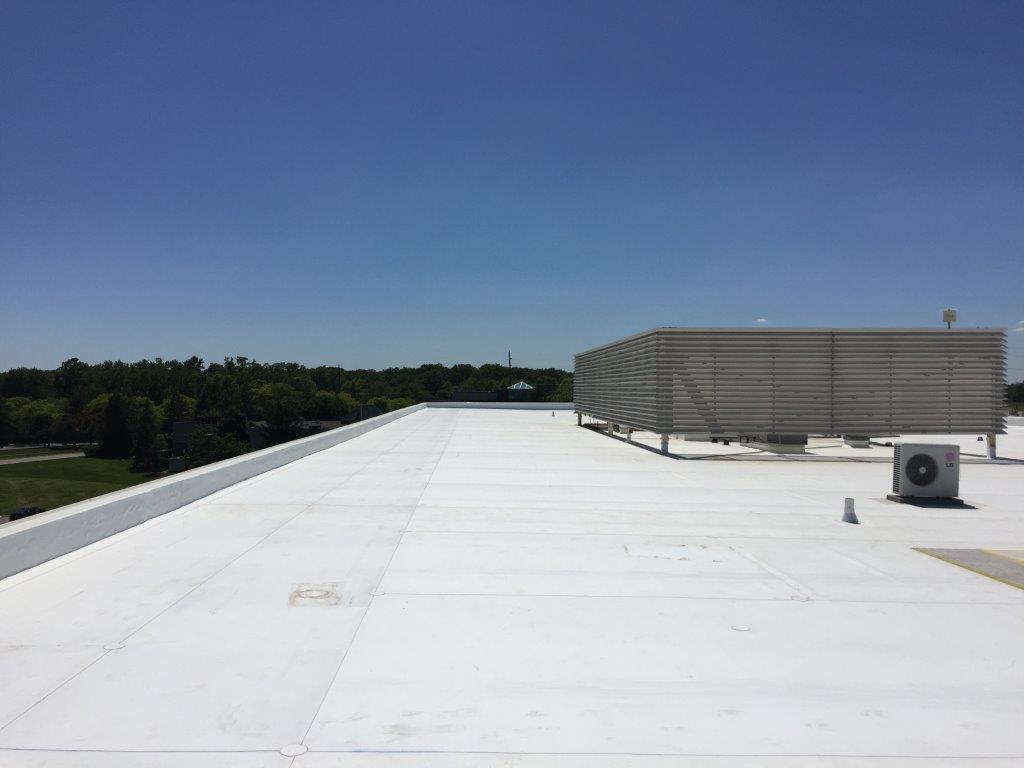
Why flat roofs fail in Fort Wayne
Flat and low-slope roofs on factories and warehouses rarely fail all at once. They fail at the weak points, and Northeast Indiana's climate finds those points quickly.
- Freeze-thaw cycles. Water that gets into a seam or flashing freezes, expands, and widens the gap. Repeated across a winter, small openings become leaks.
- Snow load and ice. Drifts at parapets and rooftop equipment stress the roof deck and clog drains when they melt.
- Rooftop equipment and foot traffic. HVAC units, exhaust fans, and maintenance traffic wear membranes where nobody is looking.
- Process exposure. Grease, chemical exhaust, and heat from the plant below can attack some membranes faster than weather does.
EPDM vs. PVC vs. TPO: how the three systems compare
PVC is usually the safest pick for plants with grease or chemical exhaust, EPDM is the value choice for clean, low-exposure buildings, and TPO sits between them on cost with performance that varies by manufacturer. The table below uses typical industry ranges; always confirm warranty terms and service life with the manufacturer for your specific product.
Factor | EPDM | PVC | TPO |
Material | Synthetic rubber | Thermoplastic, plasticized | Thermoplastic, polyolefin blend |
Seams | Adhesive or tape | Heat-welded | Heat-welded |
Grease and chemical resistance | Lower | Highest | Moderate |
Cold-weather flexibility | Very good | Good | Good |
Reflectivity (white options) | Limited | High | High |
Typical installed cost | Lowest | Highest | Middle |
Best fit | Clean, low-exposure buildings | Food, chemical and heavy-exhaust plants | General manufacturing and warehouses |
Repair or replace? A decision framework
Repair when damage is local, the membrane is otherwise sound and the roof deck is dry. Replace, or recover, when problems are spread across the roof, or when repair costs keep climbing.
- Map the moisture. Infrared or core samples show whether insulation is wet. If more than about a quarter of the roof area is wet, replacement usually beats patching.
- Count the repairs. Several leak calls in one year, or repairs in many different areas, point to system-wide failure.
- Check the age against the warranty. A roof near the end of its expected life rarely justifies major repair spending.
- Compare cost over time. A roof restoration or a full replacement can cost less per year of service than repeated emergency repairs. Ask for both numbers.
- Plan around production. Choose the approach that lets the plant keep running, with tear-off areas, noise and debris sequenced around your shifts.
Roof inspections and maintenance that extend roof life
A scheduled roof inspection program is the cheapest way to delay replacement. Most manufacturers require documented maintenance to keep a warranty valid, so keep the records.
- Inspect twice a year, in spring and fall, and after any major storm.
- Clear drains, scuppers and gutters before freeze-up.
- Check flashings, seams, penetrations and areas around rooftop equipment.
- Photograph and log every finding, and repair small defects the same season.
- Limit roof access to trained personnel and mark walkways.
Frequently asked questions
How long does a commercial flat roof last? Service life depends on the system, installation quality and maintenance. Many single-ply systems are rated for roughly 15 to 30 years, so check the manufacturer's published figures for your product.
Can a flat roof be repaired instead of replaced? Yes, when damage is local and the insulation underneath is dry. A moisture survey tells you which it is.
Does a roof replacement have to shut down the plant? Usually not. Work is phased by section so operations can continue. Your contractor should present a written plan for it.
How often should an industrial roof be inspected? At least twice a year and after severe weather.
Talk to Preferred about your roof
Preferred, Inc. – Fort Wayne serves industrial plants across Northeast Indiana. Request a roof assessment and we will tell you plainly whether your roof needs repair, restoration or replacement.